(L-R) Gerald Sendawula ex-Finance Minister interacting with Erostus Nsubuga, Chair Agro-Genetic Technologies also immediate-past Chair UBBC. (Photos by Agnes Nantambi)
Agnes Nantambi
Journalist @New Vision
UGANDA | BIOTECHNOLOGISTS | GENE | LAW
Biotechnologists have decried the delay in passing the biosafety and biotechnology bills into law, saying it is delaying faster treatment of diseases that require gene editing in humans.
Such diseases include cancers, sickle cell anemia, and HIV/Aids, among others.
According to Dr. Andrew Kigundu, a senior biotechnologist with NARO, in the crop sector, biotechnology has been used in developing new varieties that are high-yielding, disease-resistant, and drought-tolerant.
“We are developing vaccines for livestock and are going to develop vaccines for chickens and for all the livestock that the farmers are taking care of and making money from.
As we speak, biotechnology is going to be part of the new treatment of diseases that are affecting humans, like cancer, sickle cell anemia, and Hiv/Aids, among others. The treatment will be based on gene editing, “explained Dr. Kigundu
Gene editing is the manipulation of the genetic material of a living organism by deleting, replacing, or inserting a DNA sequence, to improve a crop or farmed animal or correct a genetic disorder.
Dr. Kigundu stresses that all new technologies that support livelihoods and human literature require regulation, as is the case for gene technologies in crops and those that will be used in treating human diseases.
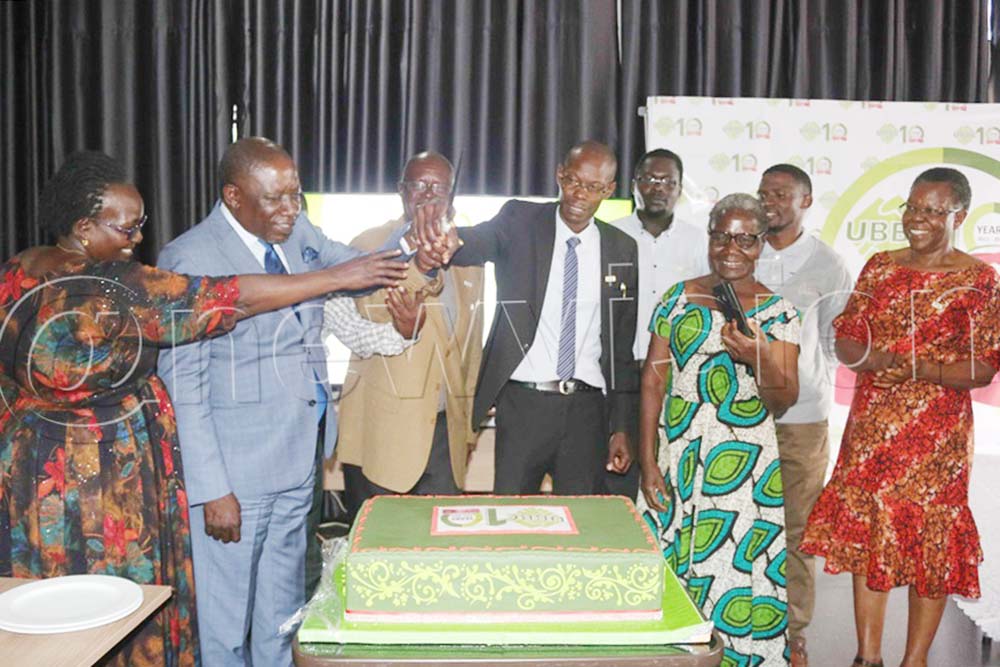
Connie Acayo assistant commissioner Ag-Extension (MAAIF) (left), with other Uganda Biotechnology and Biosafety Consortium participants cutting the cake
“We are expecting that the government will now recognize the expanding value of gene therapy and therefore provide the appropriate law that will cover the applications across all sectors,” said Dr.kigundu
Giving an example of COVID-19, which brought about the lockdown coupled with the persistent drought that affected the majority of farmers with reduced agricultural production, Dr.Kigundu said biotechnology through genetic transformation and engineering had the potential to provide solutions to all these problems to increase productivity and resistance to drought, pests, and diseases to enhance food security.
He said that when developing the gene editing technology, the treatment is based on a transformation process where genes are engineered and recombination of DNA is done to create a treatment.
He added, “Since the treatment is going to be developed for specialized patients, the way they edit the gene required for treatment of somebody “x” is not the same as it might be for somebody Y, meaning there should be a lot of personalized techniques, including engineering cells of that particular patient to provide the most suitable treatment.
The science is moving fast and a lot of human diseases like cancer which used not to have treatment will soon have treatment through the use of gene technology once the regulation is in place,”

The cake which was cut during the 10th year celebration for Uganda Biotecknology and Biosafety consontium at Fairway Hotel.
Dr. Kigundu was speaking during the 10th-year celebration of the Uganda Biotechnology and Biosafety Consortium (UBBC) at Fairway Hotel.
UBBC is a coalition of like-minded stakeholders in Uganda interested in the advancement of biotechnology and agricultural scientific innovation development.
He, however, said that stagnation in terms of the laws required to regulate the technology has frustrated scientists.
“We are happy that the president has championed its fast enactment and we hope in a few months to come, we shall have the best progress once other stakeholders have included their requirements.”
The ten years of UBBC have been full of frustrations by the donors who have injected money due to the failure to explore the technology for commercialization.
Victoria Sekitoleko, the chairperson of Uganda Agro Business Alliance, said that if anybody needs regulation, it is the private sector.
“This is a new area and we need to understand what we are getting and how we use it for our safety and promotions.”
For us, in the private sector, we are there for profits, so if biotechnology is going to bring us safe profits, we are there for it. But the only way we call it “safe profits” is when the government has come up with a regulation and the researchers have to abide by it.
Sekitooleko, who is also the vice chairperson of the Private Sector Foundation, applauded the scientists for insisting on the technology, saying the country can only be sovereign when it can handle its issues.
She implored the members of parliament to understand the bill properly so that they could pass it, saying the private sector is ready to present it in all forms.
“These scientists can explain it to you in the language you understand. Try to give it a good look and pass it so that Uganda can remain a sovereign state. Otherwise, we can’t call ourselves independent when depending on Europe and Asia for everything, “she said.
Arthur Makala, the coordinator of UBBC, said scientists will continue to give information regarding biosafety and biotechnology, saying although the bill has not yet been passed into law, a lot is taking place within government circles.
“We are optimistic that this technology will help in aspects of gene therapy, where diseases can be treated through gene editing and other approaches to addressing challenges.
We recently imported vaccines in the country which were manufactured through biotechnology, but if we don’t embrace it by enacting the law, it is us to suffer more,” he said
He applauded the government for passing the organ transplant bill into law, saying this will guard against illegal harvesting of human organs, noting that, even for biotechnology, the law can guard against such challenges.